Showing posts with label Camperdown Cemetery. Show all posts

Friday, September 21, 2012

Six-Feet-Down-Under: St Stephen's Graveyard, Newtown


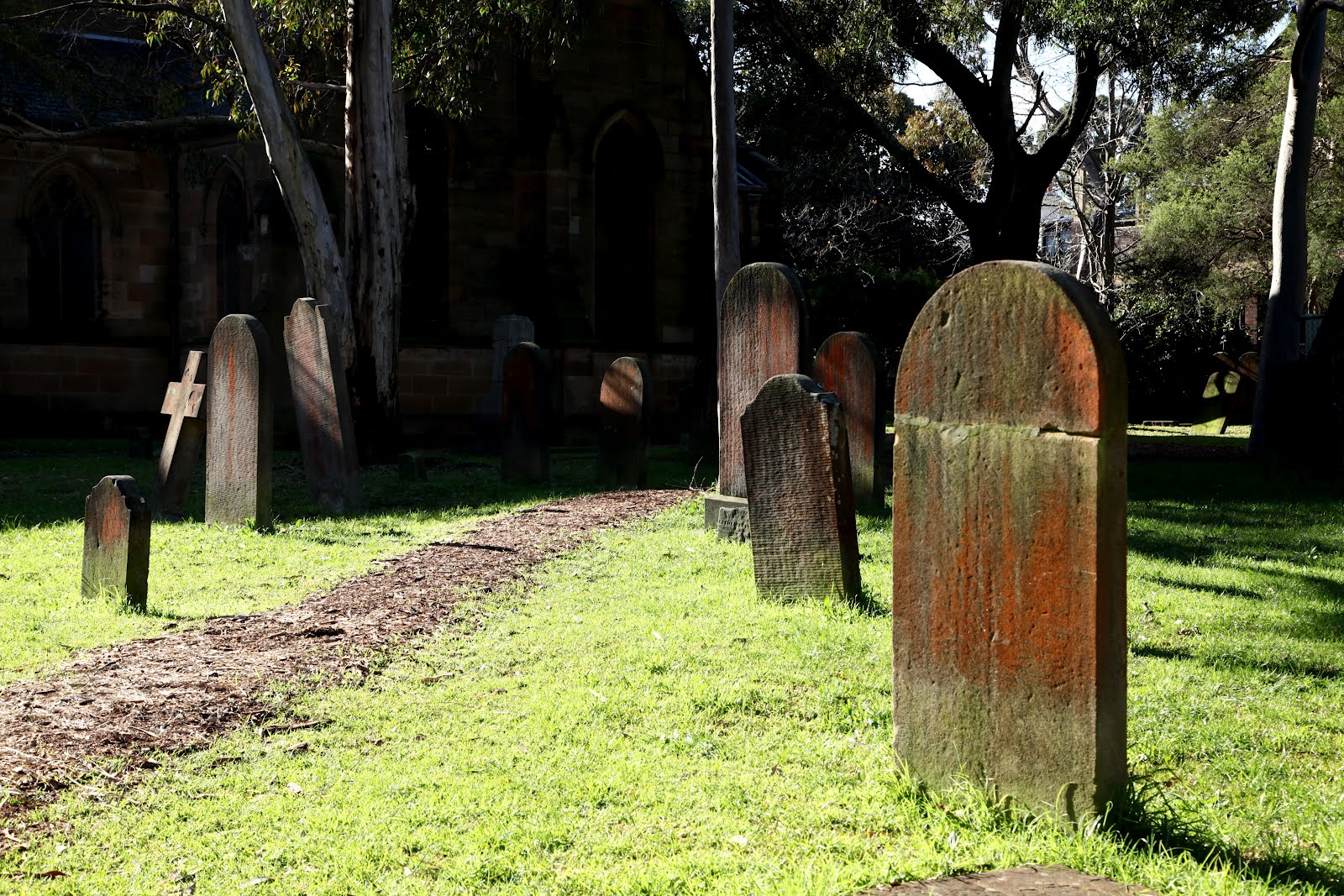
The graveyard surrounding St Stephen's Anglican Church in Newtown is also known as the Camperdown Cemetery, even though it is just a small portion of the original Camperdown Cemetery, established in the 1840s, and the recipient of some of the removals from the Devonshire Street Cemetery when that cemetery closed in about 1900. On the map down below, the entire park greensward was the original Camperdown Cemetery, but in 1938 everything outside the sandstone walls of St Stephen's was removed, and most ungraciously at that. Headstones are laid along the inside of the sandstone walls to this day. Many of the remains ... remained; unless individual families wished to reinter their ancestors in either Waverley Cemetery, Botany Cemetery, or Rookwood Necropolis.


It does have a great feel to it, this graveyard. Dark and gloomy. And unlike nearly any other cemetery I have visited in Australia, most of which are like and airy, with neatly trimmed lawns and riots of cut flowers. St Stephen's is populated with great, gnarled Port Jackson fig trees, their roots twisting and turning into the soil, and their massive canopies blocking out the sun and the air, with a shadow that admonishes the merest sliver of grass that pokes it head out of the compacted clay. Moisture lies in the uneven ground, mud sloshes, and mould and fungi flourish. All of which has a predictable affect upon sandstone, which is a porous rock to begin with. I have tried to show this aspect of St Stephen's with my selection of images.


View Larger Map

View Larger Map

This is not to condemn this cemetery, which has a piercing beauty which I have described in an earlier post on another blog. It is an engagingly historic graveyard, with memorials not only from Devonshire Street but also from the original Old Burial Ground at the Town Hall. Many of the memorial are sans remains, but the feel of the place is authentic. And there is also St Stephen's, the building. I am but a little old lady, with a stick, and noone thinks twice when I sidle into a church doorway. And I am left in peace, to wander and wonder. As I did on this earlier occasion when the only people around was a bunch of electricians.


I continue to return to Camperdown Cemetery for personal reasons. To endeavour to locate the memorial to Ann Maund, which is prone and has not disclosed it resting place to me in my three previous visits. Darn it! Ann Maund is my 4x-great-grandmother on my mother's side. And a tough old biddy she apparently was. She arrived in the colony with her convict husband, Joseph Puckeridge, in 1801, her two children dying on the journey. When Joseph died in 1818, having 7 young children, she quickly married again, had three more children and died in 1850, aged 71. I have seen a photograph of her memorial, but not seen it with my own eyes yet. But I will, I will ... eventually.


Friday, September 7, 2012

Six-Feet-Down-Under : St Matthews, Windsor


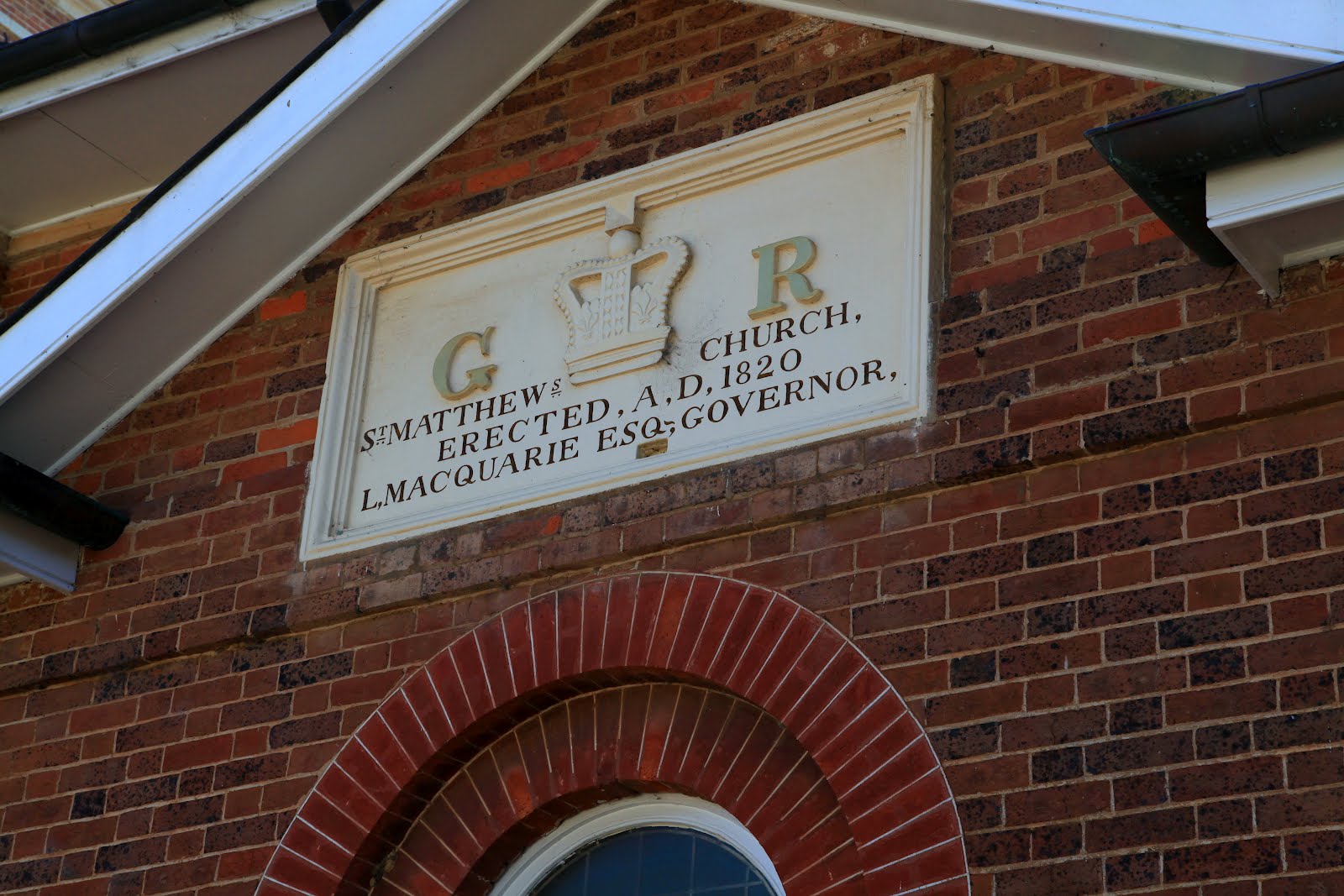
My first trip to the graveyard surrounding the Anglican Church of St Matthews in Windsor, was in the middle of 2008 when I was a member of an Historic Houses Trust (HHT) group tracing the ill-feeling between the architect, Francis Greenway, and the builder, Henry Kitchen. And the towering ego of both these gentlemen, AND the governor of the colony, Lachlan Macquarie. The church was constructed in fits and starts between 1810 and 1820, with the first service conducted in 1821. Andrew Thompson was the first to be interred in the graveyard of this church, in 1810, and interred by none other than the Governor himself.


Even with a two hour wander, there was not enough time to carefully consider each and every gravestone, so I shall return before the end of this calender year. It is unusual in Sydney to see a graveyard, rather than a cemetery, although St Stephen's at Camperdown, and St Jude's at Randwick come readily to mind, both of which are also Anglican Churches. At St Matthew's, though, there has been much freelance renovation! There is a sign at the front of the church requesting that no work be done on the graves without prior authorisation, but I suspect this is honoured more in the breach. Neither St Stephen's, nor St Jude's, has stones with the print re-inked, or stones painted white to hightlight the print. And yet, there are some wonderfully historic resting places within this churchyard. I will research some of them, singularly, for my 'Monday-In-Memoriam' post to this expanding blog.

Monday, August 6, 2012

Taphophile Tragics # 33


As I meander the headstones, I am seeing more and more of these plaques. Frequently, they are erected by descendents of 'fleeters', but not exclusively. However, they ARE left by descendents who are proud of their forbears and who wish to pay homage to their efforts and their grit.

The plaque for John Hill was erected in Camperdown Cemetery, beside a heavily weathered stone where one could JUST make out his name. He was done for having a counterfeit note in his pocket, and given 14 years for his troubles. He was 38 and left behind a wife with 6 children ranging in age from 11 to 1. All up, he married four times, but ... he was buried by his eldest son.

Rebecca Oakes was born Small, the daughter of two First Fleeters, born the year after the colony was founded. Rebecca married Francis Oakes, and bore him 14 children, Samuel died at birth, and Lucy died aged 9. That is a much lower proportion than I have seen in many other families. Rebecca's father died in 1850,aged 88, the last remaining FFer to die in the colony. Rebecca became a 'grande dame' of early Parramatta and is interred at Rookwood'


* * * * *
Welcome to the 33rd week of Taphophile Tragics.

Your contribution is most welcome. Please ensure that you include some details of the cemetery in which you took your photographs, and link directly to your post, rather than simply to your blog in general. This week, Mr Linky opens at 9:30pm Monday, Sydney time (GMT+10), and closes at 9:30pm on the Friday. When you can, please visit the other contributing bloggers to show your appreciation of their endeavours. Due to time zone variations and overcrowded schedules, some contributions are made later than Tuesday/Wednesday. As per usual, we are working with the Linky with thumbnails, and displaying the oldest entry first, with no randomising.

Monday, July 9, 2012

Taphophile Tragics # 29


The top carving is from a monument in Camperdown Cemetery, whereas the bottom two were both from Rookwood Necropolis.

* * * * *
Welcome to the 29th week of Taphophile Tragics.

Your contribution is most welcome. Please ensure that you include some details of the cemetery in which you took your photographs, and link directly to your post, rather than simply to your blog in general. This week, Mr Linky opens at 9:30pm Monday, Sydney time (GMT+10), and closes at 9:30pm on the Friday. When you can, please visit the other contributing bloggers to show your appreciation of their endeavours. Due to time zone variations and overcrowded schedules, some contributions are made later than Tuesday/Wednesday. As per usual, we are working with the Linky with thumbnails, and displaying the oldest entry first, with no randomising.